Blog
Inside the Factory: How a Leading Wool Blanket Manufacturer Controls Shrinkage & Pilling
May 23, 2026
For international textile importers, brand managers, and hospitality procurement officers, product longevity is the ultimate competitive advantage. When sourcing wholesale wool blankets, the two biggest quality risks that can damage your brand’s reputation are excessive shrinkage and surface pilling.
As a specialized wool blanket manufacturer, we believe that transparency builds trust. In this article, we take you inside our state-of-the-art production facility to show exactly how we mitigate these risks through rigorous engineering, advanced finishing, and strict quality control (QC) protocols for all our bulk wool blankets.
1. The Science of the Snag: Why Does Wool Shrink and Pill?
To solve the problem, we must understand the raw material. Natural wool fibers are covered in microscopic, overlapping scales. When exposed to heat, moisture, and mechanical friction (such as in a commercial washing machine), these scales lock together like Velcro. This causes the fabric to contract (wool shrinkage) and forces loose fiber ends to tangle into unsightly small balls (wool pilling).
Left untreated, even high-quality wool will degrade. That is why our factory intervenes at the molecular and structural levels during production.
2. Advanced Anti-Shrinkage & Anti-Pilling Finishing Techniques
To ensure our wholesale wool blankets retain their shape, size, and premium hand-feel after long-term consumer use, we implement specialized post-weaving finishing treatments:
- Singeing and Shearing: We pass the woven fabric over a precisely controlled flame to burn off loose surface fuzz. This is immediately followed by high-precision shearing blades that crop the surface to a uniform height, removing the loose fibers that trigger pilling.
- Controlled Milling (Fulling): Before cutting and stitching, we pre-shrink the fabric under factory-controlled moisture, mechanical pressure, and temperature. By forcing the fibers to safely interlock during manufacturing, we ensure the finished anti-pilling wool blanket experiences virtually zero dimensional change in the consumer’s hands.
- Washable Treatments (Optional OEM Request): For brands targeting the easy-care or machine-washable market, we apply an eco-friendly polymer coating. This microscopic layer smooths out the fiber scales, preventing them from interlocking during standard wash cycles.
3. Our B2B Quality Control Checklist for Bulk Wool Blankets
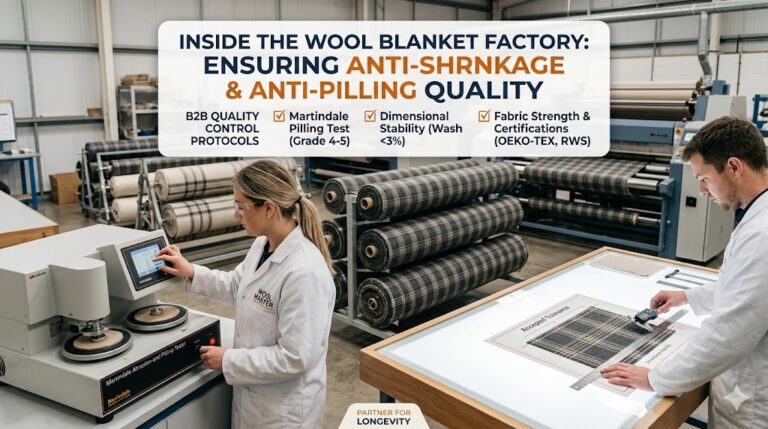
We don’t just promise durability; we scientifically verify it. Every production batch of bulk wool blankets undergoes a strict 4-step internal QC check before packaging and global shipping:
| QC Test Type | Testing Purpose & Standard | Our Factory Guarantee |
| Martindale Abrasion Test | Simulates years of friction, rubbing, and heavy wear. | Guarantees an anti-pilling wool blanket rating of Grade 4–5. |
| Dimensional Stability Test | We wash and dry sample swatches from every batch. | Limits shrinkage percentages to strict tolerances (under 3%). |
| Tensile & Tear Strength | Measures the resistance of warp and weft yarns under tension. | Ensures blankets withstand heavy institutional and utility use. |
| Certification Verification | Checks compliance with global textile standards. | 100% compliance with OEKO-TEX Standard 100 and Responsible Wool Standard (RWS). |
Partner with a Wool Blanket Manufacturer That Prioritizes Longevity
In the B2B textile market, a cheap blanket costs significantly more in the long run through customer returns, negative reviews, and lost brand loyalty. By investing in controlled manufacturing, pre-shrunk technology, and advanced surface finishing, we help your brand deliver premium products that customers will cherish for decades.
Want a firsthand look at our premium quality control? Ready to upscale your inventory with high-performing wholesale wool blankets?
Get Samples & Custom Quotes: Please feel free to Contact Our Sourcing Team today to discuss your OEM/ODM specifications.